• School News

    Read more

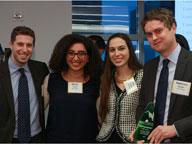
    Maria Bartiromo, with Suresh Sani, Undergraduate College Dean Geeta Menon and Professor Batia Wiesenfeld, was this year’s 2013 Sani Lecture keynote.
    Read more about Read more
  • Faculty News

    Bloomberg logo

    Prof. George Smith on Alcoa Inc.'s growth

    Excerpt from Bloomberg -- "Alcoa grew at the beginning of the 20th century to dominate U.S. industry as an integrated monopolist alongside John D. Rockefeller’s Standard Oil and Andrew Carnegie’s U.S. Steel Corporation, according to George David Smith, a professor of business history at New York University’s Stern School of Business who has consulted for Alcoa."
    Read more about Prof. George Smith on Alcoa Inc.'s growth
  • Faculty News

    The New York Times Logo

    Prof. Luis Cabral on austerity measures in Portugal

    Excerpt from The New York Times -- "'Luis Cabral, a Portuguese economist and professor at New York University, said the court still went beyond a legal ruling and delivered what amounted to 'a significant political statement,' which means that 'effectively, government expenditure cannot be reduced.' In terms of Portugal’s budgetary commitments, Mr. Cabral added, 'when you put it all together, it’s clear that things do not add up.'"
    Read more about Prof. Luis Cabral on austerity measures in Portugal
  • Faculty News

    Financial Times logo

    Prof. Larry Zicklin on research in business schools

    Excerpt from the Financial Times -- "Yes, there is a place for research but it has to be kept in its place. It can’t be the criteria for hiring or promotion. Teaching ability should be the primary factor. Students are entitled to the best teachers that schools can secure, but not the best researchers. They don’t need the person who invents theoretical models to teach them those models. They need someone to teach them who is a good transmitter of information."
    Read more about Prof. Larry Zicklin on research in business schools
  • Faculty News

    CNBC logo

    Dean Peter Henry explains how developing countries have set an example for the US

    Excerpt from CNBC -- "Discipline does not mean fiscal austerity. Discipline means a sustained commitment to a pragmatic growth strategy that's both vigilant and flexible and values what's good for the country as a whole over any individual or interest group. And so when you look at it that way and you look at what developing countries have done, they have learned from the things that we've preached to them in the 1980s and 1990s and now if we would just take a look at countries like Brazil, Chile, South America to the countries of East Asia, there's a message there for us to basically take what we taught them and apply it at home and begin to start growing again and begin to get out of this period of low expectations and underperformance."
    Read more about Dean Peter Henry explains how developing countries have set an example for the US
  • Faculty News

    CBS News logo

    Prof. Jonathan Haidt is interviewed about his book, "The Righteous Mind"

    Excerpt from CBS News -- "When I was a graduate student at the University of Pennsylvania in the late 1980s, I set for myself the task of trying to figure out what morality really is. Where does it come from? Why is it so variable around the world, yet at the same time, you see the same basic elements (such as reciprocity, care, loyalty, and authority) repeated over and over again? I studied how morality varied between India, the USA, and Brazil. But after John Kerry's loss to George W. Bush in the presidential election of 2004, the Charlottesville Democratic Association asked me to give a talk on how liberals and conservatives differ. I found that the ideas I had developed to compare different countries worked quite well to compare different sides of the political spectrum. After that talk, I decided to change my research to focus on the left-right divide, which was (and still is) tearing America apart. "The Righteous Mind" is my effort to explain that divide, while at the same time answering the question I set out to answer in grad school: what is morality, and where does it come from?"
    Read more about Prof. Jonathan Haidt is interviewed about his book, "The Righteous Mind"
  • Faculty News

    Dean Peter Henry discusses his new book, "Turnaround"

    Excerpt from AtGoogleTalks -- "2002 - 2007 was a great period for the world economy. We're in a much less robust period. In 2012, the advanced nations of the world grew only 1.3% per year. Europe actually contracted. Europe's in a recession. Emerging economies still grew at 3.5%. So in the aftermath of the financial crisis from 2008-2009, from which we're still recovering, and very importantly, we know from work by a number of scholars including Carmen Reinhart and Ken Rogoff that countries recovering from financial crises, when financial crises are the cause of the recession, countries grow much more slowly...and that means we need emerging economies to continue to grow at rapid rates in order to pull along the advanced world."
    Read more about Dean Peter Henry discusses his new book, "Turnaround"