

Educational Technology
What is the Impact of EdTech on Student Performance and School Life?
As adolescents' social lives migrated onto smartphones, their learning moved onto laptops and tablets. Chromebooks and iPads entered classrooms in the mid-2010s with the promise of enhancing learning, and the COVID-19 pandemic sped up this shift. Today, laptop- and tablet-based learning is the norm for school-aged children in the U.S. – with nine in ten U.S. public schools now running a one-student-one-device program. Given that school matters so much to children’s development, it's essential that this normalized mode of learning be evidenced to serve their learning, and that its unintended costs are well-understood.
One documented cost of digital learning in the classroom is distraction. Nearly one in three 15-year-old students in the U.S. reported being distracted by their own digital device in most or every math lesson, and one in five say they're distracted by classmates' devices. A 2025 survey of nearly 1,300 educators found that more than half reported that off-task use of school-issued laptops and tablets was one of the most common sources of classroom distraction. This is second only to the distraction from other students, and ahead of smartphones.
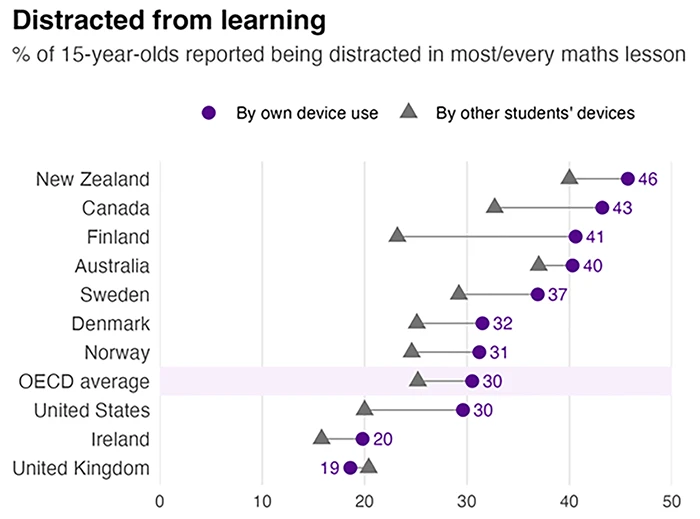
Figure 1: This dot plot shows the percentages of 15 year olds who reported being “distracted in most or every math lesson” by device use. Data Source: OECD. (2024). Managing screen time: How to protect and equip students against distraction (PISA in Focus No.124). OECD Publishing. https://doi.org/10.1787/7c225af4-en Graphed by Tech & Society Lab.
This dot plot, titled “Distracted from learning”, shows the percentages of 15 year olds who reported being “distracted in most or every math lesson” by their own device use and by other students’ devices. The percentages are provided for ten countries and the OECD average. The purple circles represent the percentage of students who were distracted by their own device use, while the gray triangles represent the percentage of students who were distracted by other students’ devices. Of the ten countries, New Zealand had the highest percentage of students report being distracted by their own device use (46%), followed by Canada (43%), Finland (41%), Australia (40%), Sweden (37%), Denmark (32%), Norway (31%), the United States (30%), Ireland (20%) and the United Kingdom (19%). The OECD average was 30%. Across the board, the percentage of students who reported being distracted by other students’ devices is generally compared to the percentage who reported being distracted by their own devices, except in the United Kingdom, where a slightly higher percentage reported being distracted by other students’ devices.
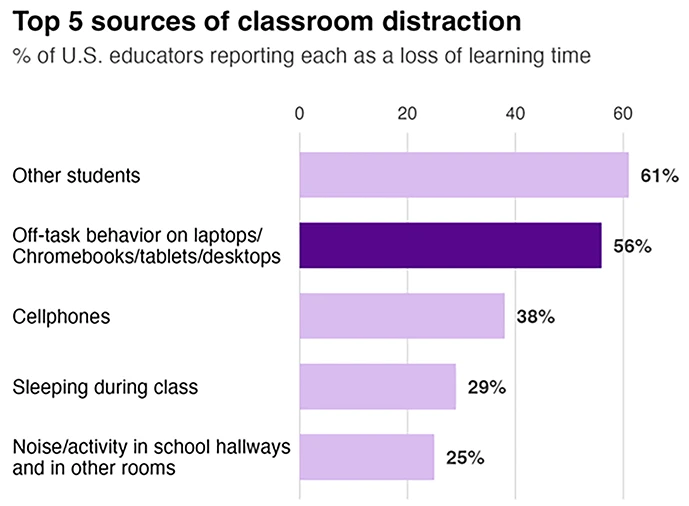
Figure 2: This horizontal bar chart shows the percentage of U.S. educators who reported each factor as a cause of lost learning time. Data Source: EdWeek Research Center survey of 1,268 teachers, school administrators, and district leaders (Jan-Feb 2025), reported in Langreo, L. (2025, May 9). Chromebooks or Cellphones: Which Are the Bigger Classroom Distraction? Education Week. Graphed by Tech & Society Lab.
This horizontal bar chart, titled “Top 5 sources of classroom distraction,” shows the percentage of U.S. educators who reported the following as leading to a “loss of learning time”: “Other students” (61%), “Off-task behavior on laptops/Chromebooks/tablets/desktops” (56%), “Cellphones” (38%), “Sleeping during class” (29%), and “Noise/activity in school hallways and in other rooms” (25%).
Children are also being pulled into this mode of learning at an increasingly young age. Long before they could read, many were handed tablets loaded with educational games and videos, their learning parcelled out into short, gamified bursts. Educational content is increasingly adopting the short, fast-paced format of social media, designed to match the elevated stimulation children have grown accustomed to from screen use outside of school. Yet the efficacy of these non-traditional learning methods, such as gamified learning, short-form educational content, and the integration of AI tools, is often not rigorously established before they are pushed into classrooms.
Our aim in this research area is, therefore, to gain clarity on the following questions. How does the ubiquitous use of devices in schools affect student learning, attention, and classroom dynamics? How does the shift to digital learning impact social skills (such as forming friendships and resolving conflict with peers) that traditional schooling has long fostered? What evidence exists for the benefits of digitalised and emerging-technology features in learning, and what potential costs do they carry?
We study these questions by analyzing evidence from a range of sources including:
- Academic literature
- Teacher and student surveys
- Large-scale international assessments
- Data from technology companies
- Press archives
Selected lab publications, essays, and resources
- Gui, M. & Abbiati, G. (2026, August 11). Does early access to social media harm later learning? New evidence from Italy. After Babel.
- Lebwohl, J., Park, E., & Rausch, Z. (2025, July 29). The achievement gap we’re not talking about. After Babel.
- Haidt, J., & Rausch, Z. (2025, March 24). An EdTech Tragedy. After Babel.