

Smartphones and Social Media
What is the Impact of Smartphones and Social Media?
When Steve Jobs introduced the iPhone in 2007, he declared, “Every once in a while, a revolutionary technology comes along that changes everything.” He was right. The smartphone placed a high-speed portal to the internet, millions of apps, and an expanding universe of social media, games, video, and pornography in every user’s pocket. These devices enabled a new personalized, portable, and always-available digital ecosystem, that supercharged hyper-viral social media and advertising-based business models designed to maximize engagement.
How has the migration of adolescents’ social lives onto smartphones, and social media in particular, impacted their well-being, mental health, attention, academic performance, and relationships? What is the relationship between smartphone and social media use and mental health outcomes? And has it contributed to the rise of adolescent depression and anxiety that began to rise in many countries around the world in the early 2010s, as you can see in Figure 1 below?
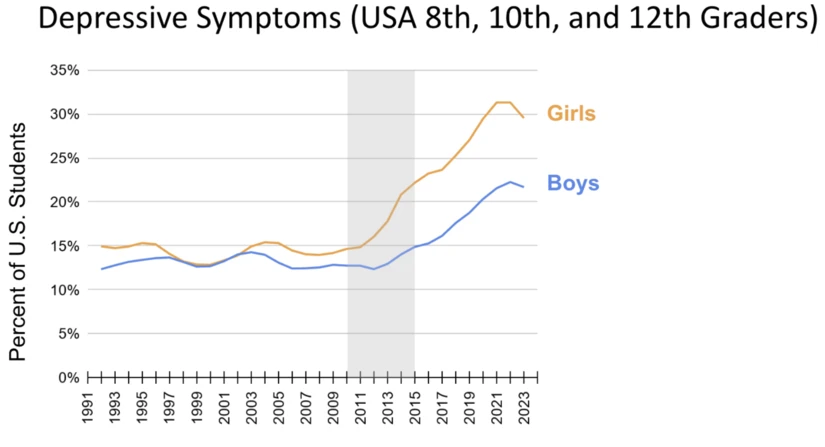
Figure 1: This line chart tracks the percentage of USA 8th, 10th, and 12th graders at 3.0 or higher out of 5.0 on 6-item Bentler Medical and Psychological Functioning Inventory Depression Scale. Three-year centered moving average, Weighted (1991-2024). Source: Monitoring the Future.
This line chart tracks the percentage of 12-17 year-olds in the U.S. who experienced a major depressive episode in the past year from 2004 to 2023. There are separate lines for boys and girls. Over the years, the rate for girls remains roughly 2 to 3 times higher than the rate for boys. Starting around the mid-2010s, both lines begin to trend upwards, with the rate for girls increasing more steeply than the rate for boys through the late 2010s. Rates of depression peak for both boys and girls in 2021.
At the Tech & Society Lab, we are answering these questions by synthesizing and analyzing evidence from a wide range of sources, including:
- Cross-sectional studies
- Experimental studies
- Population-level trends
- Qualitative accounts from young people, parents, teachers, and clinicians
- Internal research from technology companies.
We also develop polls and surveys to assess how smartphones and social media are affecting youth mental health and adolescent development.
See our review of the evidence on social media’s causal impacts on anxiety and depression at TechAndSocietyLab.org/causality.
Selected lab publications, essays, and resources
- Haidt, J., & Rausch, Z. (2026). Social media is harming adolescents at a scale large enough to cause changes at the population level. World Happiness Report 2026, Chapter 3.
- Lee, A. Y., Lim, C. H. J., Liu, X., Jin, K., Buffone, A., Iyer, R., Rausch, Z. M., Haidt, J., Fast, N. J., Hancock, J. T., & Linos, E. (2026). Measurement of American adolescents’ experiences of online harms: A nationally representative survey. JAMA Pediatrics.
- Lopes, M. V. V., Branje, K., David, A., Gennara, A., Haidt, J., Rausch, Z., Greb, N., Aslam, A., Lebwohl, J., Chaput, J., & Goldfield, G. S. (2026). Effect of social media constraints on mental health: A systematic review and meta-analysis of experiments. [pre-print]
- Haidt, J., & Rausch, Z. (2026). Two practices that understate the mental health risks associated with adolescent social media use. Perspectives on Psychological Science. (In press)
- Sigaud, L., Rausch, Z., McClean, A., & Haidt, J. (2025). Why three studies by Vuorre and Przybylski should not be used to assess the impact of social media on adolescent mental health. Clinical Psychological Science.
- Capraro, V., Globig, L., Rausch, Z., Rathje, S., ... Haidt, J., & Van Bavel (2025). A collective review on some potential negative impacts of smartphone and social media use on adolescent mental health: Results from a Delphi process. (under review)
- Rausch, Z., & Haidt, J. (2025). Why Ferguson's meta-analysis should not be used to inform debates on social media's impact on adolescent depression and anxiety: A commentary. Psychology of Popular Media. (in press)
- McClean, A., Rausch, Z., & Haidt, J. (2025). The effect of broadband access on mental health: A Review of instrumental variable studies. [pre-print]
- Twenge, J. M., Haidt, J., Lozano, J. & Cummins, K. M. (2022). Specification curve analysis shows that social media use is linked to poor mental health, especially among girls. Acta Psychologica, 224.
- Twenge, J., Haidt, J., Blake, A. B., McAllister, C., Lemon, H., & Le Roy, A. (2021). Worldwide increases in adolescent loneliness. Journal of Adolescence.
- Twenge, Blake, Haidt, & Campbell (2020). Commentary: Screens, teens, and psychological well-being: Evidence from three time-use-diary studies. Frontiers in Psychology.
- Haidt, J. & Allen, N. (2020). Scrutinizing the effects of digital technology on mental health. Nature, 578, 226-227.
- Twenge, J. Haidt, J., Joiner, T., & Campbell, W. K. (2020). Underestimating digital media harm. Nature Human Behavior.
- Skenazy, L., Rausch, Z., & Haidt, J. (2025, August 4). What kids told us about how to get them off their phones. The Atlantic.
- Haidt, J., Johnson, W., & Rausch, Z. (2025, June 18). We don’t have to give in to the smartphones. New York Times.
- Rausch, Z., Haidt, J., & Torres, L. (2024, September 12). Social media companies’ worst argument. The Atlantic.
- Haidt, J., & Johnson, W. (2024, September 17). Gen Z has regrets. The New York Times.
- Witkin, N., Lim, C.H.J., Rausch, Z., & Haidt, J. (2026, September 23). The Many Lines of Evidence That Social Media is Not Safe For Teens. After Babel.
- Haidt, J., & Rausch, Z. (2026, January 14). Mountains of evidence. After Babel.
- McClean, A., & Lebwohl, J. (2025, October 6). Does social media use at one time predict teen depression at a later time? After Babel.
- Haidt, J., & Rausch, Z. (2025, May 22). New study finds most experts share concerns about the effects of smartphones and social media on adolescent mental health. After Babel.
- Haidt, J., & Rausch, Z. (2025, April 16). Snapchat is harming children at an industrial scale. After Babel.
- Stein, D. (2025, April 11). A flawed absolution for smartphones. After Babel.
- Haidt, J., Rausch, Z., & McClean, A. (2025, February 13). Flaws in a recent Lancet study on phone use in schools. After Babel.
- Haidt, J., & Rausch, Z. (2025, January 9). TikTok is harming children at an industrial scale. After Babel.
- Lembke, A., & Rausch, Z. (2024, December 17). Applying the Bradford Hill criteria to social media use and adolescent mental health. After Babel.
- Haidt, J. (2023, April 17). Why some researchers think I’m wrong about social media and mental Illness. After Babel.