
Peer Evaluation Tool
The Learning Science Lab’s Peer Evaluation Tool is a focused, faculty-facing software utility being designed in-house to help instructors identify student contributions in group projects. We began developing it due to several converging needs and factors.
Identifying the need
The impact of AI continues to have a transformative effect on education, and more and more faculty are adopting alternative forms of assessment to mitigate AI’s impact on writing. Many of these, such as project-based work, bring additional benefits in their own right, but they also pose new challenges. One such challenge is ensuring that student groups handle the effort and responsibilities of their projects equitably and are assessed fairly for them.
One common answer to this is collecting peer evaluations from groups, but the tools available to organize this can be clunky and inconvenient. Some faculty have been left juggling dozens of manually adjusted Google forms to collect this feedback. Others have turned to existing ed-tech tools, only to find they’re over-complicated and don’t properly address this specific need. In our work piloting and evaluating such tools, we saw faculty persistently falling into this gap, and we began to ask: how can we address it?
Extending capabilities
There’s another side to the AI revolution, and this one’s more positive than AI-generated essays: work that would have once been well outside the capabilities of a small team is now possible. If the tool we were looking for didn’t exist, could we build it?
Assistant Director of Educational Technology Victoria Tralies began prototyping what such a tool could look like with NYU Stern’s Gemini account.
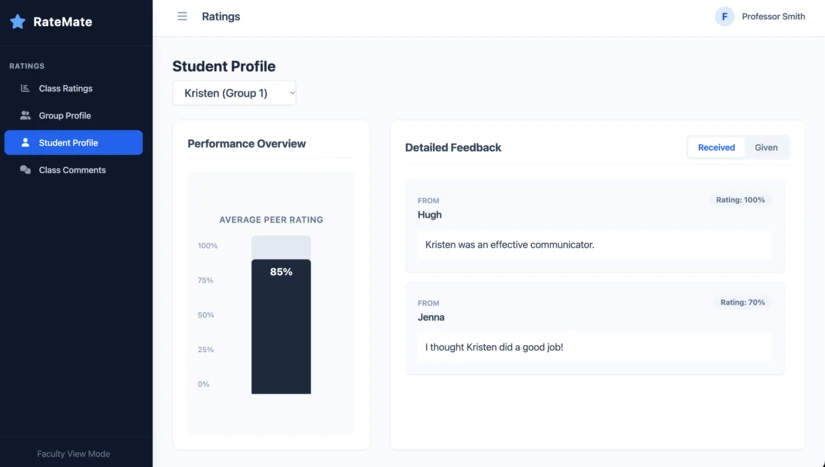
The original tool prototype. It allowed the team to quickly explore user interactions and assess the app’s viability.
The results were promising, and the team decided to begin developing the idea into a full app. Hugh Mackey and Kate Arendes joined the effort to begin programming the tool. Finally, Ben Cramer added his UX/UI expertise to assist with design and coordinate early user tests, turning development into a team-wide effort.
Of course, moving from a prototype to a functional product is often more work than it would first appear. These kinds of in-house projects are still new. Work like this would have taken dedicated developers, a design team, and a sizable budget just a few short years ago — now, almost anyone can build it. But where do you put it once you have? We began the work of coordinating with Stern and NYU IT to discuss the options for hosting, user account management, secure data storage, and other considerations that would be vital for handling sensitive student data.
The result is a polished, secure app hosted on NYU infrastructure that not only serves its intended purpose, but lays the groundwork for future efforts.
How it works
The app follows a simple four-step workflow:

- Create a project — Faculty sign in with their NYU account and set up their evaluation.
- Form groups — They set up the student groups with one of several methods: import from Brightspace, complete a template spreadsheet, or manually add and organize groups within the app.
- Launch evaluations — Students log in to complete evaluations for their teammates and themselves.
- Review results — Faculty can see progress while the feedback period is open. Once it closes, they’re provided a comprehensive dashboard where they can see the evaluations and quickly identify problem areas with student contributions.
The road ahead
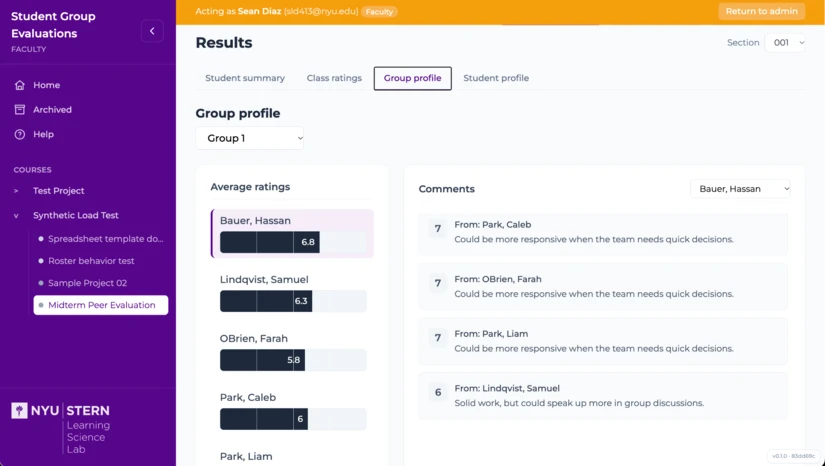
A screenshot from the final app.
We’re piloting the Peer Evaluation Tool in Fall 2026 with a small cohort of faculty to identify bugs, refine the user experience, and ensure the application has all the necessary functionality for a wide release. We plan to make the tool available to the Stern community by early 2027.
Interested in testing the tool?
Do you have a group project that would benefit from this kind of organized peer evaluation? More testers are welcome! Contact us at learning.science@stern.nyu.edu to learn more.