
Personalizing student reflection questions: Brian Hanssen, Management Communication
How can we personalize learning for our students and connect course content to their professional experiences and goals?
Through our Faculty Innovation Fellows partnership with Brian Hanssen, Director of NYU Stern’s Management Communication Program and Clinical Professor of Management Communication, we explored a practical way to personalize learning in a course with 35 experienced EMBA students.
The problem
Professor Hanssen’s Executive MBA students brought substantial professional experience and distinct goals to the classroom. But broad reflection questions at the end of each class could not fully account for those differences or consistently help each student connect course content to their professional life.
To make personalized reflection scalable, we developed a workflow that combined structured student input, a customized AI chatbot using Gemini’s Gems, and Professor Hanssen’s review. The workflow served two purposes: it gave the AI chatbot (the Gem) the information needed to draft personalized questions, and it gave Professor Hanssen a more complete picture of students’ professional experience, course goals, and evolving reflections.
The result
Professor Hanssen generated reflection questions for all 35 students over two class sessions. He found the approach to be an effective way for students to tie their professional experiences to course content.
The takeaway
Personalizing learning does not have to mean creating every resource from scratch. By partnering with the Learning Science Lab, faculty can identify practical strategies, including thoughtfully designed uses of generative AI, to help students connect course content to their individual experiences, goals, and future work.
From broad reflection prompts to personalized questions
The challenge: making personalized learning scalable
Professor Hanssen gave students reflection questions intended to help them connect course content to their careers. However, since every student received the same broad questions, the activity could not fully account for the professional experience and individual goals that each student brought to the course.
Professor Hanssen partnered with us to explore a more personalized approach. We worked with him to identify the information that would help tailor reflection questions to individual students, including their professional experience, learning goals, and previous reflections.
Together, we built a Gemini Gem—a customized chatbot that used this information to generate two personalized reflection questions for each student. Professor Hanssen reviewed the questions for accuracy and relevance before sharing them with students in welcome letters at the beginning of class.
Our solution: creating a Gemini Gem to generate personalized reflection questions
To make personalized reflection scalable, we developed a workflow that combined structured student input, a customized chatbot, and Professor Hanssen’s review. Students shared information about their professional experience and course goals, the Gem used that information to draft personalized questions, and Professor Hanssen reviewed the results before sharing them with students.
1. Entry surveys and class reflections
To generate the personalized reflection questions, two pieces of data were collected via Google Forms and stored in separate Google Sheets spreadsheets: an entry survey and responses to previous reflection questions.
At the beginning of the Communication for Consultants course, Professor Hanssen shared a survey asking students to describe their past consulting experience, how they best learn, and two goals that they have for taking the course.
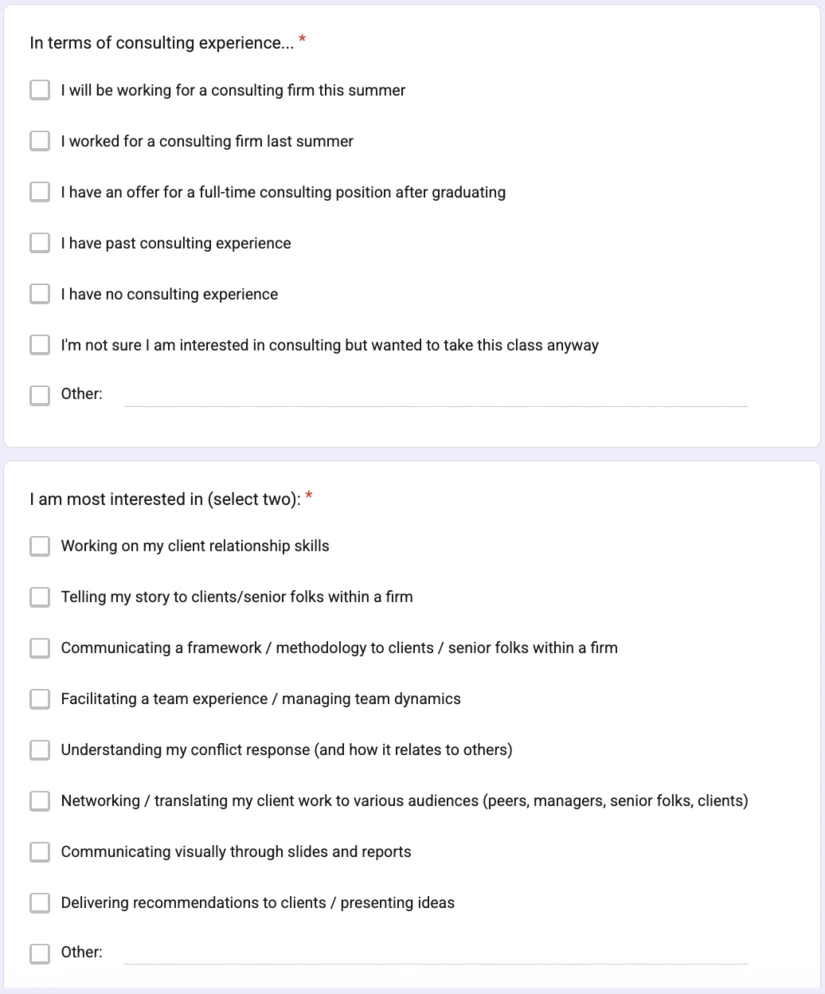
He collected these via Google Forms, where the results were stored in a Google Sheet that could easily be connected to the Gemini Gem, a customized chatbot.
2. Welcome letter generation
Using that Gem, Professor Hanssen generated personalized reflection questions for each of his students. After generating the questions, he reviewed and revised them to ensure that they were relevant to each student and consistent with their survey responses and previous reflections.
3. Letters shared
At the beginning of class, Professor Hanssen shared the reflection questions via welcome letters. Students used the questions to relate course content to their professional experience and goals for the course.
AI made personalized reflection possible, but faculty review remained essential
Professor Hanssen generated and reviewed personalized welcome letters for all 35 students in his Spring 2026 course over two class sessions. The project showed that a customized chatbot could turn structured information about students’ experience, goals, and prior reflections into individualized reflection questions, while giving Professor Hanssen a clearer understanding of the students he was teaching.
The process also revealed an important limitation. Although the Gem made it possible to generate a first draft of personalized questions efficiently, reviewing every letter for accuracy and relevance remained time-consuming. Professor Hanssen’s judgment was essential to ensure that the questions reflected each student’s context.
Conclusion
Professor Hanssen’s project demonstrates one way generative AI can support more personalized learning: helping faculty create tailored materials that connect course content to students’ professional experiences and goals. At the same time, it highlights the importance of designing AI-supported workflows that leave room for faculty review.
The project also prompted Professor Hanssen to consider how AI can be used thoughtfully not only in his own teaching, but across the Management Communication Program.
Interested in trying a new tool or pedagogical approach in your classroom?
We are always reviewing requests for collaboration, and we identify our yearlong fellows each summer. Fellows are expected to actively participate in innovation, providing feedback, assisting in data collection, and regularly meeting with the LSL team. To inquire about partnering with us, send us an email at learning.science@stern.nyu.edu.