
Navigating Complexity Resources
Every NYU Stern senior Business major takes the NYC Consulting Capstone, a semester-long course in which student teams work on real business problems for corporate partners. One of the course's core learning objectives is navigating complexity: taking initiative without a roadmap, framing a problem that hasn't been clearly defined, and changing course as new information comes in.
Capstone faculty reported that students found this difficult. Teams struggled to identify first steps and had trouble adapting along the way. The Learning Science Lab set out to build resources that address the problem.
Analyzing the problem
Turning something as open-ended as navigating complexity into actionable resources is a real challenge. The LSL worked closely with NYU Stern’s Experiential Learning Team and Capstone faculty member Matthew Statler to explore different options, and we quickly realized that no single approach could address students’ difficulties. Students were, in fact, falling into two traps:
- A structured, planning-first mindset that left them over-committed to their initial proposed solutions
- A lack of familiarity with the tools, resources, and frameworks they could deploy throughout their project to navigate those changes
The resulting proposal included multiple deliverables designed to address each of these issues:
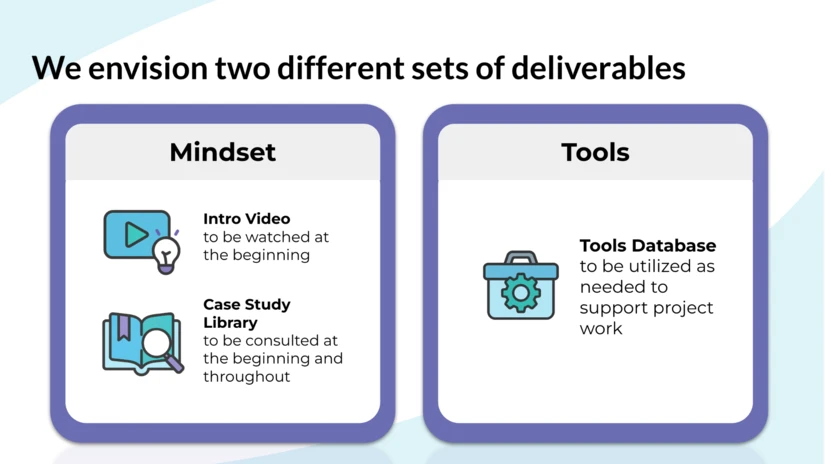
A slide from the initial project proposal
Toolkit: Tools for Navigating Complexity
After careful analysis with the team and course faculty, we identified ten frameworks that consulting teams use to structure problems and move projects forward.
Every entry covers what the framework is and when to use it, a visual of its structure, a step-by-step application guide, a worked Capstone example, best practices and common pitfalls, use cases, how it's used in professional practice, and further reading. The Toolkit's introduction makes clear that frameworks are a starting point for a team's thinking, and that many more exist beyond the ten included — but it gives undergraduate teams a solid grounding to start from.
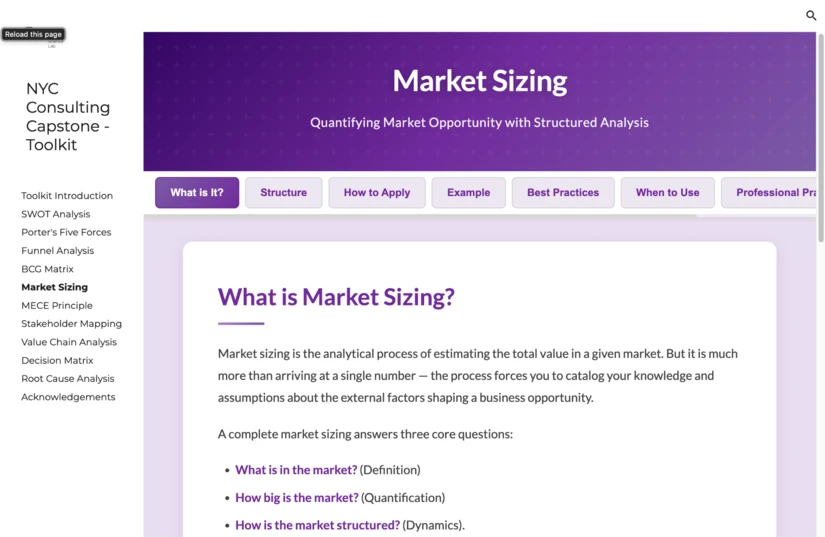
A Toolkit entry page
Student Case Studies
Two case studies document exemplary Capstone projects. Each follows one team through its engagement: the brief, the point where the team's assumptions broke down, how it adapted, and what the experience taught.
These grounded, real-world examples help set student expectations for the unpredictable challenges they’ll face, both in NYC Capstone and in their professional work.
Introductory video
This short interview-based video features perspectives from Capstone faculty and clients, setting the stage for what’s expected of students in the course and what successful projects look like.
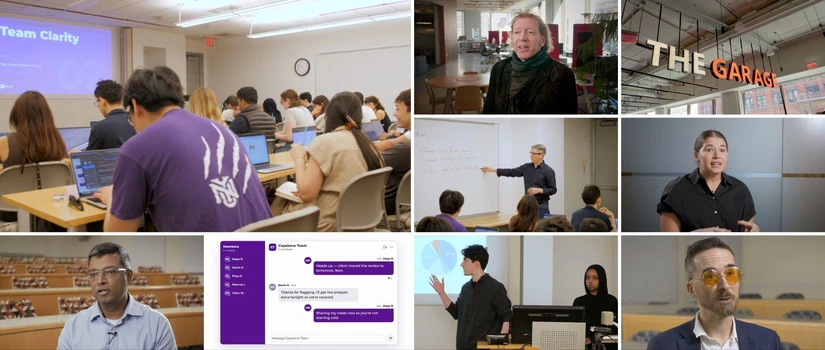
Select stills from the Intro Video
Navigating our own complexity
The project was unique in that it involved contributions from a wide number of stakeholders: faculty, students, corporate partners, administrators, and subject matter experts. All of these participants made valuable contributions, but also had competing schedules, suggestions, and — in the case of some partners — critical NDAs that needed to be respected and navigated.
This resulted in adjustments to the project timeline and scope along the way, just as we ask of students. In many cases, these changes improved the final result, resulting in more focus and relevance in the Case Studies and Intro Video, for example.
The resources were released to Capstone students in Fall 2026. The Toolkit and the Market Sizing tutorial are hosted on Google Sites and require an NYU Stern sign-in, whereas the case studies are published in Brightspace.
Both resources were planned with room to grow. The Case Study Library will add projects from future semesters, and the Toolkit can take on new frameworks as faculty and students identify gaps.
Do you have a course development challenge?
The Learning Science Lab is here to help. Whether it’s a long-term project or a one-on-one consultation, we serve as thought partners for your learning design. Contact us at learning.science@stern.nyu.edu.