
Blended Learning and Capstone
The MS in Business Analytics and AI program is based on a blended learning approach combining in-person classroom time and independent study.
Modules are divided into three phases: pre-module, module, and post-module.
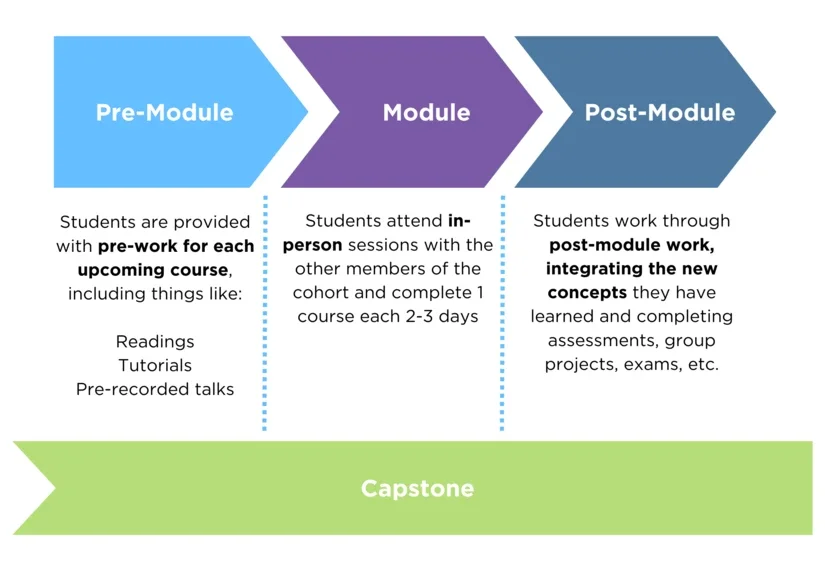
Pre-module: Research Phase
This begins 4-6 weeks prior to the in-class teaching session. Students prepare for the module by completing qualitative and quantitative assignments that include readings and cases, tutorials and diagnostics, and exercises and written assessments. Completion of the pre-module material ensures a more rigorous and productive classroom experience. All learning materials will be posted to our online Learning Management System.
Module: In-Person Class Sessions
This will be an intensive, full-time period of rigorous in-class learning to absorb the advanced material and actively collaborate with your peers and faculty. Each module contains special events, guest speakers, and other opportunities to engage with your MSBAi cohort and alumni community. Students are required to attend class during normal business hours each day with some additional evening engagements.
Post-module: Application
The post-module is designed as the implementation phase of the module. Students are challenged to apply the material and concepts covered during the pre-module phase and residential period to solidify their learning. Deliverables are in the form of case studies, written assignments, projects, and group work.
Throughout the pre- and post-module phase, students will be part of study groups that encourage collaboration and peer-to-peer learning.
Capstone
The MSBAi Capstone is an integrative year-long team project that gives students the opportunity to demonstrate an understanding of the core competencies taught throughout the program and apply them to real business concerns. The result is a unified and practical case presentation on a topic of the group's choosing.
Project Framework
- Each group will consist of 4–5 participants from diverse backgrounds, encouraging a broader understanding of business analytics.
- The project will span the course of the program, enabling participants to enrich their projects with learning from each module.
- The final deliverables for the project consist of a paper and final presentation.
Capstone work runs throughout the duration of the program, starting in Pre-Module 1. Capstone includes deliverables assigned from specific courses, as well as a charter, executive summary, first draft, and final draft. Students will practice presenting Capstone materials at various stages throughout the year leading up to the final presentation in Module 6.
Featured Capstone Projects
Examples of Past Projects
In addition to our featured Capstones, view additional projects from the Class of 2026 below.
This Capstone project is conducted in collaboration with Alorica, a global Business Process Outsourcing (BPO) company. When realized operations diverge from pricing-time assumptions, providers often incur costs that are not fully recoverable, commonly referred to as pricing or margin leakage. The objective is to improve pricing decision-making by systematically incorporating operational risk into contract pricing before contracts are signed. Specifically, the project models the behavior and variability of three operational drivers—Average Handle Time (AHT), Agent Attrition, and Call Volume—using historical internal data. Ultimately, Random Forest and Gradient Boosting models provide pricing teams with structured risk signals to ensure decisions remain human-led while benefiting from data-driven assessments.
Keywords: Operational Variability ○ Pricing Intelligence ○ Decision-Support System
The Commercial Real Estate (CRE) sector is navigating a period of heightened volatility driven by shifting interest rates and evolving investor appetite. This project identifies and validates the most effective predictors for analyzing default probabilities in CRE loans. By analyzing historical performance data across various property types, the team aims to develop a robust model that anticipates defaults before they manifest as balance sheet losses. Initial findings suggest that Net Cash Flow (NCF) and Property Valuation Rank are stronger indicators of health than simple occupancy rates alone. Ultimately, this project produces a final default probability score to allow for the cross-referencing of individual loan files against broader market trends.
Keywords: Net Operating Income ○ Market Volatility ○ Commercial Real Estate
GamerPsyche Analytics examines how gaming behaviors, motivations, and play styles relate to players' psychological wellbeing and life satisfaction. The core objective is to move beyond one-dimensional engagement reporting toward a psychologically informed framework that differentiates between healthy engagement and patterns associated with burnout. Using a dataset of 13,464 survey responses, the project tests empirically grounded relationships between engagement patterns and mental health outcomes. The primary research objective is to examine how observable patterns—such as play intensity and motivational orientation—relate to generalized anxiety and life satisfaction. Ultimately, the research informs dashboards that allow stakeholders to explore how changes in design differentially impact player segments.
Keywords: Psychographic Motivations ○ Game Design ○ Player Segmentation
Small Amazon merchants operate in a competitive, opaque marketplace where demand signals are noisy and platform fees compress margins. The Smart Buyer project addresses this gap by developing an analytics-driven decision framework to help sellers make better inventory and pricing decisions. The project combines public Amazon marketplace data and historical Keepa signals to surface predictive signals and heuristic decision tools. A central goal is to validate generalizable decision signals, such as Demand Momentum and Competitive Intensity, that merchants can apply within their own categories. Decision quality depends on identifying what is likely to remain sellable under realistic platform constraints.
Keywords: Demand Momentum ○ Merchant Decision Support ○ Inventory Optimization
Pacific Trading is a wholesale distributor of giftware that has historically sourced most of its inventory from China. Escalating tariffs and rising import costs have rendered intuition-based decision-making inadequate, making data-driven frameworks critical. The team developed predictive models to identify at-risk customers using Random Forest algorithms. Additionally, demand forecasting models were built to optimize inventory replenishment timing and minimize stockout risks. By achieving these objectives, Pacific Trading aims to protect high-value customer relationships and maintain profitability despite rising tariff pressures.
Keywords: Customer Retention ○ Demand Forecasting ○ Tariff Impact Analysis
Restaurant expansion in Manhattan is high stakes due to expensive rent and neighborhood demand that varies sharply. This capstone develops SmartStart Solutions, an end-to-end analytics framework that supports pre-opening zone selection and early performance monitoring. The core deliverable is a Success Probability Index (SPI) that ranks Manhattan zones using transparent sub-scores across five pillars. The final product surfaces a ranked list of zones paired with transparent drivers, enabling stakeholders to see why a specific recommendation was made.
Keywords: Market Archetypes ○ Success Probability Index ○ Zone Selection
Early-stage venture capital investing relies heavily on qualitative intuition, often defaulting to heuristics when evaluating pre-seed and seed stage companies. This project investigates whether measurable signals present at the time of a fundraise—such as round size and investor identity—can predict healthy fundraising progression. Using a comprehensive dataset of over 70,000 organizations, the project identifies data-driven indicators that complement or challenge existing investor intuition. The culmination of this work is an interactive dashboard and predictive model designed to serve as a practical decision-support tool. This provides a quantitative foundation for decisions that are currently made almost entirely on qualitative grounds.
Keywords: Startup Analytics ○ Venture Capital ○ Fundraising Progression