
Phillip Hogan, MSBAi '25
“I would have been watching the biggest technology shift of my lifetime from the sidelines. Instead, I get to help deliver it.”
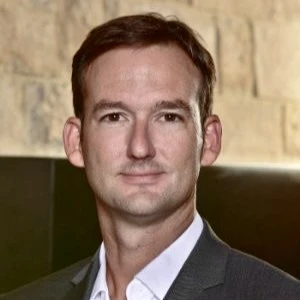
Phillip Hogan is an Engagement Manager and Delivery Lead on Scale AI’s Public Sector team, where he leads technical program managers and engineers in building and delivering AI solutions for government customers. He came to Scale after 21 years in the Navy as a pilot and intelligence officer, retiring in 2024. A two-time NYU graduate, Phillip earned his MS in Cybersecurity Risk and Strategy in 2022 before returning to pursue the MSBAi program.
He recently spoke with Stern about translating two decades of military leadership for the private sector, and how the MSBAi became his bridge into the AI industry.
Where were you in your career when you decided to pursue this MSBAi program? Why did you choose Stern over other avenues?
I retired from the Navy in 2024 after 21 years as a pilot and intelligence officer. I’d finished NYU’s MS in Cybersecurity Risk and Strategy in 2022, and I wanted to do something different next. Generative AI was moving out of the lab and into real products, and I didn’t want to spend my second career playing catch-up. By the time I started the MSBAi, I was already working in AI, delivering AI and Machine Learning solutions for government customers. If I was going to invest in myself, this was the time to do it.
I’d worked with big data and predictive analytics for most of my career, but the field was moving fast, and I wanted a deeper technical foundation to keep up with it and lead in it. Having been through an NYU program already, I knew the instruction would be demanding and the material would be current. That’s what I was looking for.
What was the biggest professional challenge you were facing before joining the MSBAi, and how did the program help you solve it?
My biggest challenge was making my experience count. After 21 years in the Navy, I knew how to lead teams and use data to make decisions, but I had a hard time showing a private-sector hiring manager why that mattered to them.
The program helped me close that gap. I spent my time writing code, building machine learning models, and working through advanced analytics problems. Just as important, I learned to frame my work in terms of business value and return, which made it much easier to explain what I could bring to a company.
What excites you about the field of analytics and artificial intelligence, and how do you see yourself contributing to the field? How will your experience at Stern help you make that contribution?
What excites me most is helping people keep up with AI. The tools are moving fast, and most organizations are still figuring out how to use them well. I want to help close that gap so people can put these tools to work without worrying about falling behind.
My job puts me between the engineers building the tools and the analysts who use them. A lot of what gets in the way isn’t technical. It’s people not knowing what a model is doing, when to trust it, or how to explain its value to leadership. I see my contribution as working across that divide so both sides can do their jobs better.
Stern’s program is challenging and relevant. The professors are world renowned experts in their fields, and they teach for real-world application rather than theory alone. Everything I learned in class, I applied at work the same week. It was striking how quickly the coursework turned into solutions for real problems on the job.
What has the immediate value-add of the program been for your career?
The most immediate payoff was getting hired at Scale AI. My Navy experience opened the door, but the MSBAi gave me the current AI knowledge to go with it. In interviews, I could talk about mission results and also about how models are built, tested, and deployed. I use what I learned every day, whether I’m scoping a project, working through a problem with our engineers, or walking a customer through the trade-offs.
How has the program influenced your long-term career direction or ambitions in analytics, AI, or data-driven leadership?
The program made it clear to me that I want to lead AI adoption, especially where the stakes are high. Long term, I’d like to move into senior leadership, building the teams and strategy that take AI past the pilot stage and into everyday use.
Has the MSBAi shifted the direction of your career, whether through a promotion, a pivot, or doors that would otherwise have stayed closed? Where do you think you’d be without it?
Yes. For me, it was the bridge from the military into the AI industry. Without it, I probably would have taken the usual route into defense contracting or consulting. That’s good work, but I would have been watching the biggest technology shift of my lifetime from the sidelines. Instead, I get to help deliver it.
What advice would you give someone considering this program but unsure whether it’s the right time?
I don’t think there’s ever a perfect time. I started this program while I was transitioning out of a 21-year career, and I’d make the same choice again. AI is changing every industry right now, and waiting only makes it harder to catch up. If you’re already asking whether you need these skills, you probably do. The program is set up for people who work full time, so I was able to apply what I learned right away.