
Accounting Apps
Why does a profitable business sometimes run out of cash? How does a depreciation estimate change the story a company’s financial statements tell? The Learning Science Lab is collaborating with Stern’s accounting faculty on interactive applications that let students explore these questions by making decisions and seeing their consequences.
Traditional interactive modules are often built in platforms that limit the types of interactions students can perform. In recent years, AI development has opened the door to custom scenarios and simulations that can more closely reflect real-world work, and offer students compelling new ways to explore educational concepts and practices.
Several accounting professors had already leaned into this potential by creating interactive exercises. But they required assistance progressing from an experiment to a fully deployed interactive module suitable for use across a full department. That’s where the LSL came in, assisting in testing, offering design feedback, aligning separately-authored modules on branding and style, and coordinating hosting for the team’s small but growing collection of interactive experiences.
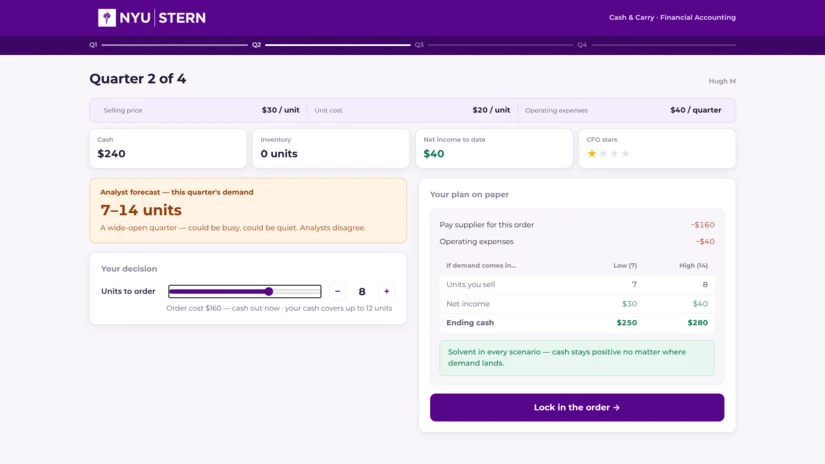
The Cash & Carry app features a leader board, so students can see where they stand and try to improve.
The Financial Statements Simulator follows a coffee-cart business and asks students to predict how transactions affect its statements. In Cash & Carry, students manage a retailer through four quarters and explore the difference between earnings and cash on hand. A depreciation simulation puts students in the CEO’s chair, where accounting choices affect reported results and raise questions about managerial judgment.
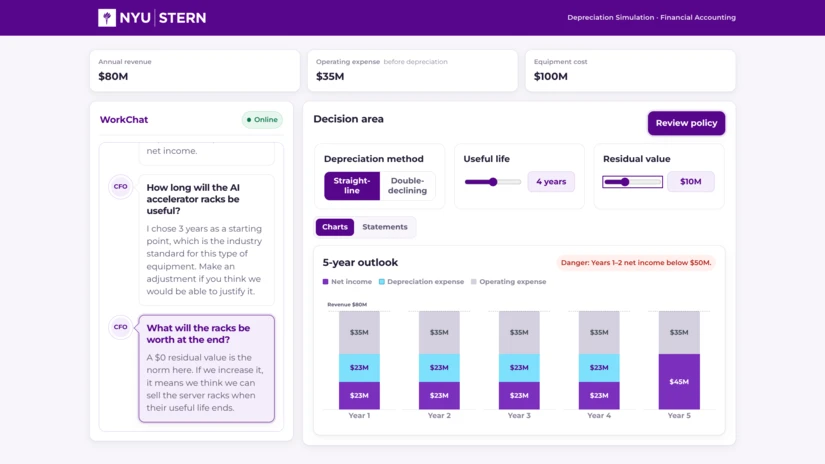
The Depreciation simulation features multiple endings so students can see how different decisions affect the outcome.
Designed for short classroom activities or independent practice, the apps are accompanied by teaching notes with learning goals and ideas for discussion. We are also developing a 10-K Explorer to help students compare financial information from real companies.
Alongside development, we are planning how to gather student feedback on the apps’ ease of use, relevance to course concepts and contribution to classroom engagement. That feedback will help guide further development.