
CSB Blog
From Learning to Practice: How Stern MBA Fellows Put Sustainable Business to Work
—
By Mariah Maldonado and Skyler Nourse
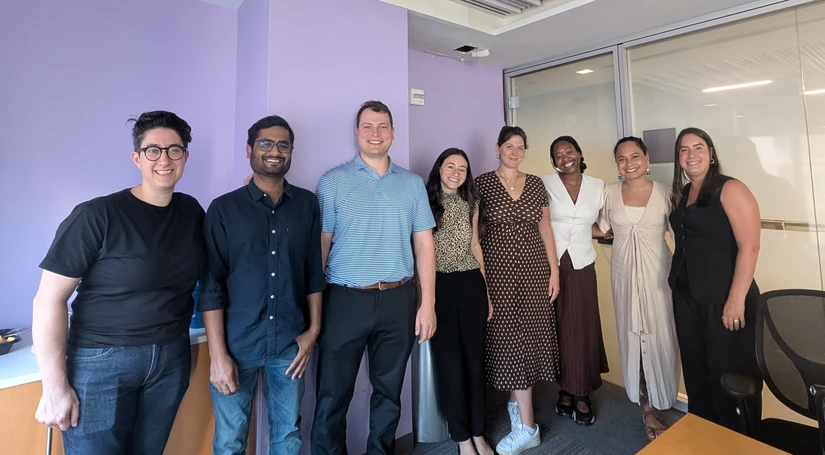
For six Stern MBA Summer Fellows, summer 2026 meant taking sustainability out of the classroom and into the decisions that shape how businesses operate.
Working across food, fashion, consumer packaged goods, financial technology, and supply chain, fellows took on projects spanning that brought their sustainability and human-rights training into organizational settings.
Their experiences illustrate the breadth of sustainable business practice and the role experiential learning can play in preparing students to contribute impactfully in their careers.
Launched in 2014, the NYU Stern MBA Summer Fellowship in Sustainability and Human Rights is coordinated jointly by the Center for Sustainable Business (CSB) and the Center for Business and Human Rights (CBHR). The program combines specialized training with direct experience, connecting students with organizations pursuing social, environmental, and financial goals.
Connecting sustainability to business strategy
At Nestlé Health Science, Renata Lara Arizpe (MBA ’27) explored how sustainability can serve as a competitive advantage.
Her fellowship involved research and communications work across the value chain—from supply chain and packaging to marketing and commercialization—to understand sustainability as a core operating model. She paired those insights with an in-depth look at customer priorities across circularity, regenerative agriculture, health access, and climate trends. The work helped leadership consider how to translate Nestlé’s existing initiatives for different stakeholders and advance the company’s mission of resilient, healthy value chains.
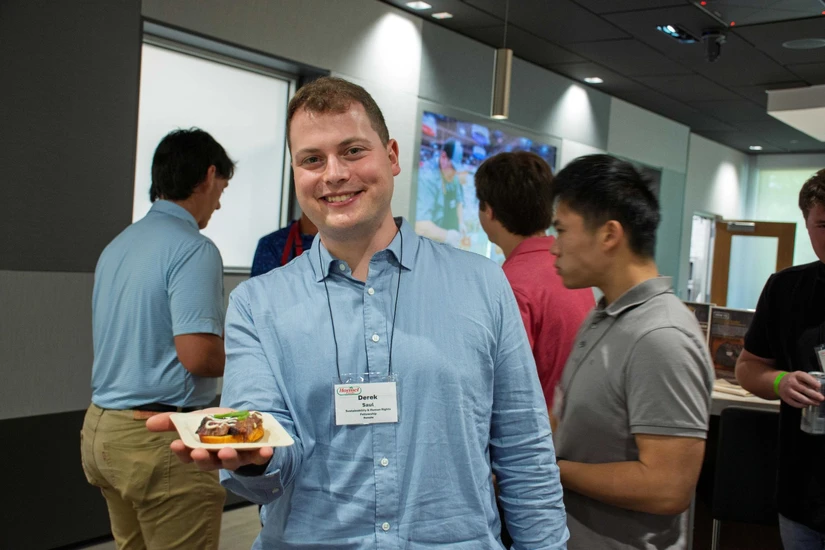
At Hormel Foods, Derek Saul (MBA ’27) focused on enterprise sustainability communications strategy in support of Hormel’s Good Feeds Us All sustainability platform.
Derek benchmarked more than 20 food and consumer packaged goods companies, analyzed consumer research, and interviewed internal stakeholders to identify how Hormel could differentiate its approach. He synthesized those findings into recommendations for the company’s sustainability positioning, messaging, governance, and five-year roadmap, ultimately presenting the work to senior leadership.
Together, these projects show the work required to make the case for sustainability internally: connecting it to business priorities, aligning stakeholders, and building support for action.
Exploring circularity through materials and packaging
For Rachel Gindi (MBA ’27) and Leah Sorkin (MBA/MPA ’28), the summer focused on circularity, waste reduction, and reusable packaging.
On Tory Burch’s sustainability team, Rachel developed cross-functional approaches to reduce waste and advance circularity. She streamlined the returns process to help minimize product destruction and strengthen data quality; designed a waste-diversion system with sorting workflows and nonprofit recycling partnerships; and assessed resale options, including trade-in platforms and third-party partnerships.
Presenting this work to leaders across materials, operations, e-commerce, legal, and corporate development reinforced a central lesson: sustainability initiatives need to do more than make a strong environmental argument. They must solve real operational problems and align with the priorities of the teams responsible for carrying them out.
At Just Salad, Leah served as a Sustainability and Supply Chain Fellow, leading strategy work on the company’s reusable bowl program while also supporting supply-chain analysis and a greenhouse gas inventory. Drawn to Just Salad’s B-Corp status, she gained firsthand exposure to values-driven leadership and the trade-offs involved in operating a mission-driven business at scale.
Designing for social impact
The fellows’ work also extended to financial inclusion, responsible recruitment, and supply-chain labor.
As a Strategy and Product Fellow at Esusu, Rohan Agrawal (MBA ’27) developed a new card strategy for thin-file renters—people who pay rent, utilities, and telecommunications bills on time but see little of that history reflected in their credit files.

Unlike traditional starter credit products that lock away deposits while charging high interest, the prefunded card Rohan helped design uses the member’s own deposit as the payment source, making zero interest possible by design. The work directly supported Esusu’s mission of financial inclusion and demonstrated how a clear mission constraint—“build a product that cannot harm the user”—can help resolve complex structural questions.
At the Fair Labor Association, Akiera Charles (MBA ’27) focused on responsible recruitment and supply-chain labor, bringing together her specialization in supply chain management and global sourcing with practical experience.
Her primary project involved developing a Responsible Recruitment Knowledge & Action Hub. Akiera researched global labor standards and interviewed stakeholders to design an accessible digital resource that helps brands and suppliers translate policy commitments into practical action. Balancing a long-term vision with real-world constraints sharpened her skills in project scoping, stakeholder management, and cross-functional collaboration.
Building the skills to put sustainability into practice
Across these assignments, fellows gained hands-on experience with sustainability and human-rights issues in the field. The fellowship supports that learning through training featuring academics and practitioners, followed by opportunities to apply those lessons during the summer.
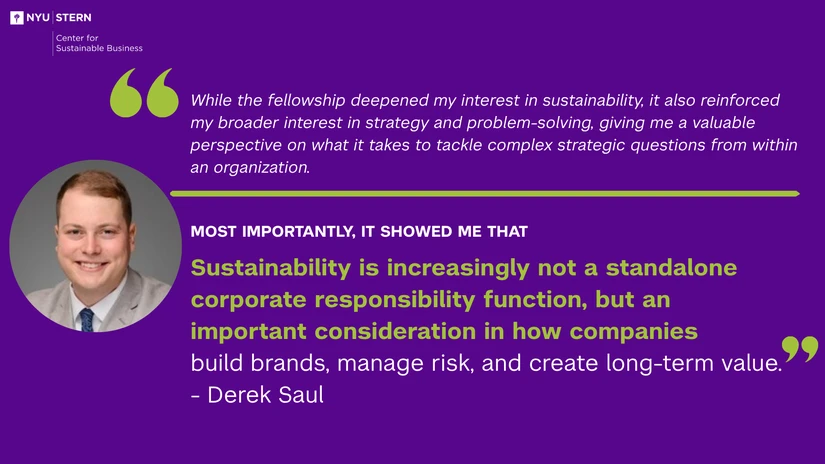
"While the fellowship deepened my interest in sustainability, it also reinforced my broader interest in strategy and problem-solving, giving me a valuable perspective on what it takes to tackle complex strategic questions from within an organization. Most importantly, it showed me that sustainability is increasingly not a standalone corporate responsibility function, but an important consideration in how companies build brands, manage risk, and create long-term value." - Derek Saul
For host organizations, the program offers access to MBA talent and fresh perspectives on social and environmental challenges. For students, it provides an opportunity to explore how sustainability and human rights connect to the work they hope to pursue.
Explore the fellows’ individual reflections and learn more about the NYU Stern MBA Summer Fellowship in Sustainability and Human Rights.