

Automotive Framework
Novel research assesses sustainability efforts across the value chain, identifying ten strategies for the automotive industry to drive value creation
THE FRAMEWORK
What Is the ROSI™ Automotive Sustainability Framework?
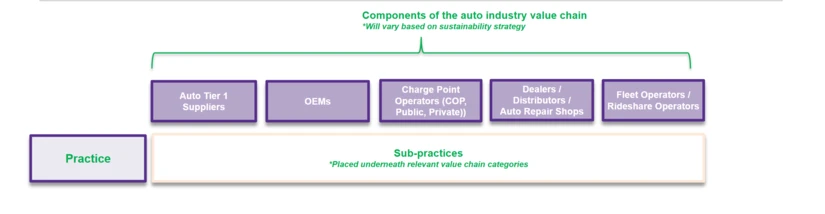
Developed by the NYU Stern Center for Sustainable Business, the Return on Sustainability Investment (ROSI™) Automotive Sustainability Framework maps ten sustainability strategies across the automotive value chain, identifying the practices, financial benefits, ROSI™ value drivers, and proposed monetization methods associated with each.
Based on an academic review and interviews with automotive company executives and subject-matter experts, and sponsored by PwC, the research builds on the foundational ROSI™ methodology, which provides a systematic approach to identifying and monetizing the financial benefits of sustainability actions.
The global automotive industry - producing more than 90 million vehicles annually and generating more than $2.75 trillion in revenue - sits at the center of the energy transition. Operating on net margins of 2–7%, with raw materials representing 50–60% of manufacturing cost, automakers have little room to absorb rising input costs, supply chain disruptions and carbon costs, including the EU's Emissions Trading System and incoming Carbon Border Adjustment Mechanism. Yet these same pressures create some of the clearest near-term opportunities for financial value creation, particularly in decarbonization and electrification, sustainable materials sourcing, and circularity.
EXPLORE THE RESEARCH
Ten Automotive Sustainability Strategies
CSB’s research maps ten automotive sustainability strategies, each linking specific practices to financial benefits and a proposed monetization method that supports the internal business case for sustainability investment.
Click here to explore each strategy (see the framework deck for a quick overview of the research).
CSB maps the automotive strategies and practices to nine ROSI™ value drivers — operational efficiency, risk management, sales and marketing, customer loyalty, innovation, supplier relations, talent management, media coverage, and stakeholder engagement — across the automotive value chain.
- The full findings are presented in the white paper Embedding Sustainability into Automotive Business Strategy Drives Transformation and Financial Value.
Case Study: Sustainable Materials Sourcing
Steel and aluminum are the dominant inputs in light-duty vehicle manufacturing, accounting for approximately 66% of vehicle weight by material and a major share of the 50–60% of total manufacturing cost attributable to raw materials. On such thin margins, getting materials strategy right, from designing and procuring to end-of-life disposal methods, is central to competitive advantage. The regulatory environment is intensifying this pressure, as the EU Emissions Trading System has pushed carbon prices from approximately €30 per ton in 2018 to roughly €65-80 per ton in 2024-2025, with the EU Carbon Border Adjustment Mechanism now converting those embedded carbon costs into direct invoiced costs on imported raw steel and aluminum.
Our research finds that for companies with high materials intensity, a phased transition to green steel and aluminum can generate 8-9 figure value depending on company size, before considering green financing benefits, potential P/E improvements associated with emissions reductions, or fleet buyer revenue premiums. The financial model developed weighs options regarding the types and characteristics of green materials, along with the timing of transitioning, to ensure companies create benefits tied to reduced input costs, direct and indirect regulatory liabilities, and price volatility. It enables companies to capture financial value, as CBAM, fleet CO₂ standards, and battery content rules create compliance deadlines that reward early movers and penalize delay.
$36–$83 millionNPV over five to ten years
For an OEM producing 1 million vehicles annually, under conservative assumptions.
$151–$339 millionScaling for a larger OEM
For a 4 million vehicle OEM under the same assumptions.
Before counting green financing benefits, P/E multiple improvements, or fleet buyer revenue premiums.
MORE RESOURCES
Explore the Automotive ROSI™ Framework and Tools
Automotive Framework Overview Deck
A summary of the Automotive ROSI™ Framework, key findings, and the financial case for sustainable materials sourcing.
Interactive Automotive Framework
This interactive tool allows users to sort by their position in the automotive value chain across ten sustainability strategies and map practices and sub-practices to financial benefits, ROSI™ value drivers, and monetization methods. Practitioners can use it to scope sourcing initiatives, while investors can trace how individual practices create measurable value across the supply chain.
-
Video Demo: Automotive Interactive Framework Airtable - NYU Stern Center for Sustainable Business
Framework Overview Video
Watch a short walkthrough of the Automotive ROSI™ Framework, featuring the Sustainable Sourcing strategy for OEM value chain participants and examples of the associated financial benefits and monetization methods.
ROSITM Automotive Financial Models - Transitioning to Greener Steel and Aluminum
Two companion Excel models quantify the financial returns of transitioning to more sustainable materials, green steel and aluminum, under EU and US regulatory conditions, including tariff, EU ETS, and CBAM cost exposure.
DISCLAIMER: These resources are provided by NYU Stern Center for Sustainable Business for informational and educational purposes only. They are not to be used for commercial purposes except through prior written agreement. While every effort has been made to ensure the accuracy and reliability of the data and calculations contained within these resources, NYU Stern Center for Sustainable Business makes no warranties, express or implied, regarding their completeness, accuracy, or fitness for a particular purpose. Users assume full responsibility for any decisions made based on the outputs of these resources. New York University and its affiliates, faculty, staff, and students shall not be liable for any direct, indirect, incidental, or consequential damages arising from the use of these resources. These resources are provided “as is” and may be subject to updates or modifications without notice. Users must cite NYU Stern CSB when using the resources and references to ROSI™ materials. Users should verify all results independently and consult with appropriate professionals before relying on the data and results provided. By using these resources, you acknowledge and agree to these terms.

ROSI™ Automotive Sector: White Paper
Applying ROSI™ to the automotive sector, this paper maps ten sustainability strategies and quantifies their financial returns, with a deep dive into the financial case for sustainable materials sourcing, grounded in research with two confidential OEM partners. Findings extend to any materials-intensive manufacturer facing carbon costs and supply pressure.

ROSI™ Automotive Sector: Sustainable Sourcing EU Excel Models
Estimate your exposure to EU carbon costs, including the EU ETS and CBAM, plus tariff and input price volatility. Built for OEMs, Tier 1 suppliers, and other EU-based manufacturers, the model takes your sourcing data and outputs projected cost avoidance and financial benefit under different scenarios.

ROSI™ Automotive Sector: Sustainable Sourcing USA Excel Models
Estimate your exposure to U.S. Section 232 tariffs, CBAM exposure on EU-bound exports, and input price volatility. Built for OEMs, Tier 1 suppliers, and other US-based manufacturers, the model takes your sourcing data and outputs projected cost avoidance and financial benefit under different scenarios.
Thank You to Our Collaborators and Research Team
The ROSITM Automotive framework and model were developed in collaboration with confidential automotive manufacturing partners and independent consultants, drawing on both proprietary research and practical industry knowledge.
CSB contributors to the project include Elyse Douglas, Risa Hiser, Tensie Whelan, Aishwarya Jadhav, Fiona Gee, and Anestya Pramana.