

ROSI™ Food and Agriculture Sustainability Strategies Framework
ROSI™ empowers food & agriculture companies to drive value across the supply chain by monetizing investments in sustainable business practices
After decades of maximizing food production to lower costs and keep up with population increases, the food & agriculture industry is now urgently faced with material issues impacting the environmental, social, and economic sustainability of their businesses. Climate change-induced ecosystem impacts, farmer and worker safety, supply chain disruptions, and consumer behavior shifts present challenges as well as significant opportunities to invest in sustainability initiatives that deliver both financial value and positive societal impact.
Leveraging the unique Return on Sustainability Investment (ROSI™) methodology developed by NYU Stern CSB, The Food and Agriculture Sustainability Strategies Framework identifies 12 sustainability strategies that can be applied across the value chain to address these challenges, develop more resilient organizations, and drive financial value.

Note: The ROSI Food and Agriculture Sustainability Strategies Framework primarily focuses on arable agriculture (land-based crop cultivation) and pastoral systems (livestock domestication). While aquaculture and fisheries are key components of the global food system, this framework does not include strategies targeting these industries as they warrant separate research and analysis. Please feel free to reach out to sustainablebusiness@stern.nyu.edu if there is an interest in supporting research in these areas.
Click here to explore each of the strategies, including specific practices and monetization tools that can help calculate the financial benefits of sustainability investments.

Mediating factors: benefits are categorized across nine impact categories
- Customer Loyalty: Attract an increasing community of conscious buyers & consumers, while reducing retention costs
- Innovation: Create new revenue streams using sustainable business models
- Media Coverage: Increase a company's media presence with the development of traditional and social media content
- Operational Efficiencies: Optimize corporate and supply chain efficiencies to lower cost and increase profits
- Risk Management: Encourage risk mitigation and resilience within the value chain
- Sales and Marketing: Increase volume of sales through brand and marketing policies
- Stakeholder Engagement: Improve goodwill among the broader stakeholder community (e.g. NGOs)
- Supplier Relations: Improve upon the relationships between the company and its suppliers
- Talent Management: Attract and retain high-quality talent
DISCLAIMER: These resources are provided by NYU Stern Center for Sustainable Business for informational and educational purposes only. They are not to be used for commercial purposes except through prior written agreement. While every effort has been made to ensure the accuracy and reliability of the data and calculations contained within these resources, NYU Stern Center for Sustainable Business makes no warranties, express or implied, regarding their completeness, accuracy, or fitness for a particular purpose. Users assume full responsibility for any decisions made based on the outputs of these resources. New York University and its affiliates, faculty, staff, and students shall not be liable for any direct, indirect, incidental, or consequential damages arising from the use of these resources. These resources are provided “as is” and may be subject to updates or modifications without notice. Users must cite NYU Stern CSB when using the resources and references to ROSI™ materials. Users should verify all results independently and consult with appropriate professionals before relying on the data and results provided. By using these resources, you acknowledge and agree to these terms.
Case Studies

Anheuser-Busch
Anheuser-Busch (AB) explored the benefits of ROSI's soil health strategy. Working with barley growers to accelerate the adoption of nutrient management practices on-farm improved operating efficiency, reduced Scope 3 carbon emissions, and enhanced brand value. ROSI results show benefits amounting to ~$40 million in 10-year NPV and an average annual operating income improvement of ~$7.5 million.

Hero Group
Hero Group explored the benefits of ROSI's biodiversity and ecosystem conservation strategy. Working with farmers to promote sustainable bee-friendly farming practices improved fruit pollination and yields, reduced input costs for growers and led to carbon sequestration benefits for achieving Scope 3 targets. A 10-year NPV of €3.6 million (before costs) was estimated with an average annual operating income impact of €650K.

Ingredion
Ingredion explored the benefits of ROSI's food waste strategy. Working with an affiliate corn grower to promoting the use of AflaPak™, an aflatoxin biocontrol product, to reduce on-farm waste in corn increased sellable yields for growers, lowered risk of supply disruption, and improved operational efficiency for the company. The results showed the potential for a 9.3x return on investment to develop AflaPak™ and a 10-year NPV ~$15.5 million.
The Food and Agriculture Sustainable Strategies Framework was created from various projects applying the ROSI methodology to real company divisions and processes. View additional case studies that informed the framework including with Greyston Bakery, Kashi, McDonalds, Natra, and Nespresso.
Thank You to our Sponsor, Company Partners, and Research Team
The framework was designed with the practical knowledge from ROSI™ collaborations. Inputs into the framework include HSBC-funded research projects, with partners AB InBev, Hero Group, and Ingredion as well as individually-funded ROSI projects with Applegate, Cargill, Investindustrial, Mars, and McCormick.
CSB contributors to the project include Tensie Whelan, Chisara Ehiemere, Elyse Douglas, Divya Chandra, Rithu Raman, Maggie Paruta, and consulting support from Martin Delaroche. Lastly, we thank our student assistants Kathryn Danielsen (MBA '21), Alice Davison (MBA '24), and Stella Yao (MPA '21).

ROSI™ RESOURCES
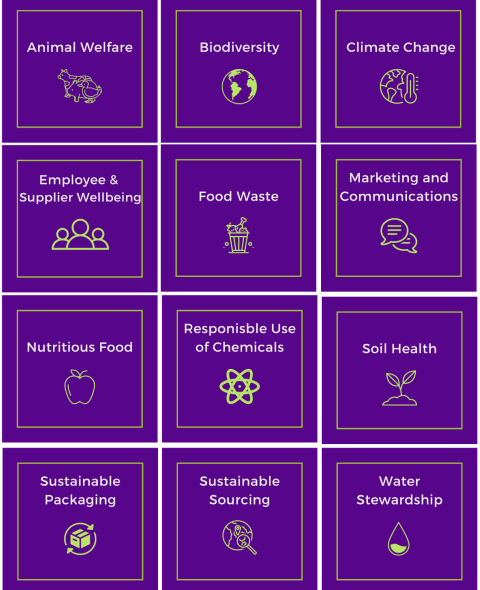
Strategies
Based on research, experience, and engagement with industry leaders, we have identified 12 sustainability strategies, each broken down by practices and benefits.

Monetization Tools
Interactive monetization tools allow practitioners to insert their data and measure the potential value of sustainability initiatives if applied in their own organizations.
Case Studies
ROSI projects have been implemented with project partners ABInBev, Hero Group, and Ingredion to demonstrate the strategies in practice.