
Meet Dean Bharat Anand: The Strategist, The Pioneer, The New ‘New Yorker’
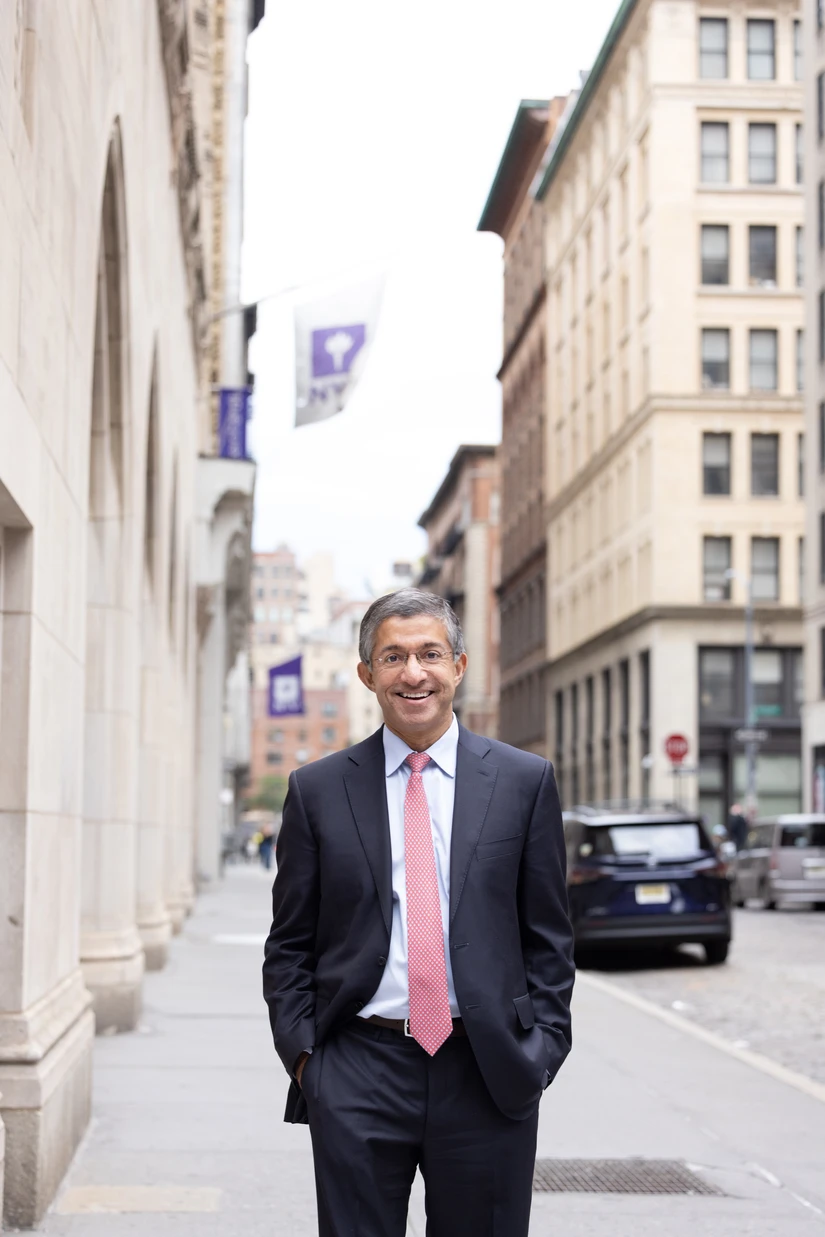
Q&A with Dean Anand
You were at the Harvard Business School for 27 years and held senior roles at the university. What attracted you to NYU Stern?
We’re at a rare and pivotal moment for higher education. Questions around cost and access, changing demand for traditional degrees, and transformative technologies like AI are reshaping the landscape in ways we haven’t seen in decades.
I was very fortunate to have spent most of my career at Harvard, where I grew as a person, scholar, and leader. Through various leadership roles, I saw many of these challenges up close. It’s tempting to view them as enormous, even existential, challenges. But they also represent extraordinary opportunities for institutions with the strength and ambition to think differently. That’s what intrigued me about Stern.
When Stern reached out, I saw a remarkable combination of assets that, if we could build on them with intention, could position Stern not just to adapt to what’s coming, but help shape it. The advantages were unmistakable and extended well beyond our core MBA program: our location in the global business capital of the world, offering unmatched access to firms across industries and the potential for deeper partnerships; NYU’s unparalleled global network, anchored in New York, Shanghai, and Abu Dhabi, with the opportunity to leverage these campuses even more fully; an outstanding undergraduate business program that is exceptional in reputation and selectivity; and flexible programs like the Langone Part-Time MBA that allow people to learn without leaving their careers.
It’s rare for any business school to have this combination of assets and programs. Looking at these strengths, I felt genuinely excited by the opportunity to work alongside colleagues to help steward Stern’s next chapter. And my family did play a role in my decision too. Our daughter simply said to me, ‘Dad, change is good, and you’re ready!’
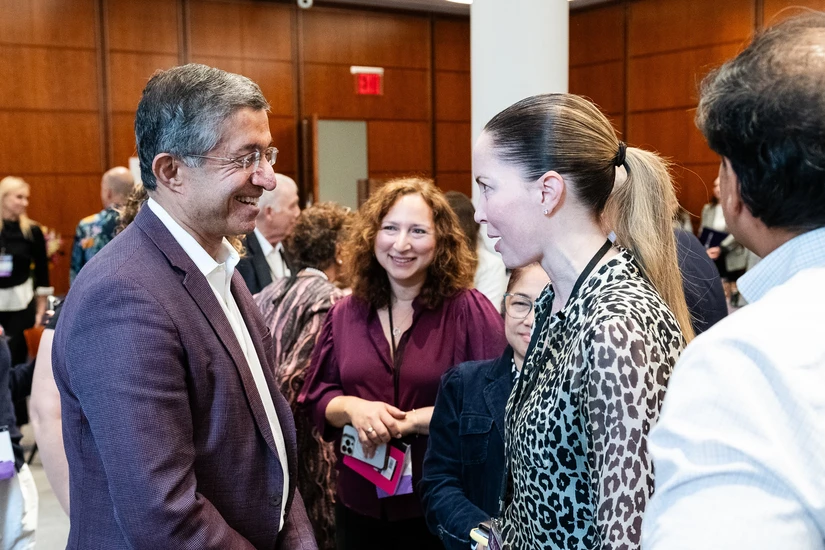
Photo: As part of NYU Alumni and Families Weekend, Stern hosted a Luncheon with the Dean
You’ve just marked your one-year anniversary of your deanship. What has impressed you so far about Stern?
Stern’s a very special place. There’s a ‘can do’ attitude that I personally love. And there’s also a unique blend of warmth and competence. There are very talented faculty and administrators here, but what stands out is it’s simultaneously a place of humility and collaboration. You feel the ‘IQ + EQ’ combination in the air. That’s rare. I think it provides a foundation to do great things.
And the students, of course, are exceptional. The world’s clearly taking note of this. I was astonished to learn about our undergraduate program’s extraordinary selectivity, which stands today at around a 4% acceptance rate with a 70% yield, putting it on par with the very best institutions anywhere. You see this reflected in the students themselves; graduate and undergraduate, they have a strong sense of purpose and an incredible drive. There’s a kind of entrepreneurial energy to them. Something about New York City seems to attract students who are resourceful, ambitious, and building or pursuing things on the side that could easily become full-time endeavors.
I feel really fortunate to now be part of this community and welcomed into it, and I don’t take this privilege for granted.
You had an ambitious goal of meeting with each faculty member, not a small task. What were your biggest takeaways from meeting with so many faculty?
Coming here from outside Stern, I didn’t want to make assumptions. I felt it was important to first just listen. Meeting every faculty member one-on-one seemed like the best way to understand Stern through the lens of people who know it best. I decided to meet my faculty colleagues in their offices. It turned out to be the best way to get to know them, to understand Stern, and to start to experience what makes the place tick. You begin to understand the unwritten rhythms of the School, the subtle dynamics, relationships, and parts of the culture that otherwise only reveal themselves over time.
Spending all this one-on-one time clearly made it very challenging on my calendar! Looking back, it was the most valuable investment of my time during those first few months. Those individual conversations surfaced insights I wouldn’t have gotten in group settings. They also helped me get to personally know our nearly 200 faculty members. I followed this up with extensive meetings (this time in small groups) with nearly 300 administrators and staff.
I got a sense of the deeply collegial research and work culture that defines Stern. Faculty and staff work as genuine partners, and junior faculty feel supported by senior colleagues. I also noticed a strong entrepreneurial spirit: people feel empowered to start new initiatives, programs, activities. If we can preserve this spirit even as we develop clear, school-wide strategic priorities, I think it can be an even more powerful combination.
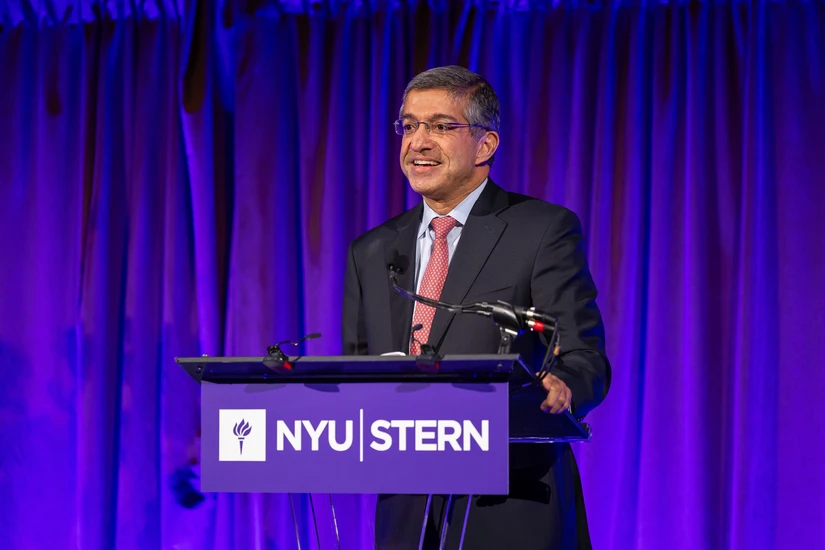
Photo: Dean Anand at the Haskins Giving Society Awards Dinner in April 2026
Alumni are an integral part of the Stern community and you hit the ground running by traveling the world and meeting with over 1,000 of them. How do you see their role in the School’s future?
Because so many alumni live in New York City, it’s very convenient to meet them for coffee or breakfast and be right back in the office. Our location is something we often take for granted. But I tried not to just stay close to home. I intentionally traveled to some of the places farthest from Washington Square—initially Seoul, Shanghai, Taipei, Hong Kong, Shenzhen, and later Abu Dhabi, Mumbai, and London. I was amazed at the deep and enduring affinity our alumni in these faraway locations feel for Stern, transcending geography. What struck me most was how ready our alumni are to step up and find ways to contribute to our future. Our conversations often ended with some version of ‘How can we help?’ They want to engage more with the School, whether it’s hosting events, making introductions, or opening doors for our students. Their commitment was genuine and energizing.
With over 115,000 alumni worldwide, I’d think one of our greatest opportunities is to make it even easier for alumni to engage with the School and with one another, all over the globe. I’m excited for what we can do to deepen those connections, both in New York City and around the world.
You’ve been working with the faculty and administrators to craft a vision for the future. How do you do that in a world that is constantly changing?
One of the challenges of leading any institution today is that the future is becoming harder, not easier, to predict. That doesn’t mean we throw our hands in the air, or react to things as they come. It’s exactly why enduring principles matter. They help you make good decisions even when circumstances change.
That’s why we’ve been organizing our thinking around three ideas: Access, Breakthroughs, and Connections, that I refer to as our “A, B, C’s.” Access goes beyond affordability, it means learning anytime and anywhere through digital channels. Breakthroughs, or excellence, has always defined our institution, for example in our research and teaching. How can we keep innovating in the way we design and deliver education, and create experiences that are truly transformative for our students? Connections speak to the need of the hour for every institution of higher education today. With digital formats drawing students away from the classroom, and with polarization, fragmentation, and loneliness, connection becomes even more essential: connections across students, faculty, alumni, New York City, and our global campuses.
Whatever changes come, we want Stern to be an institution that doesn’t simply respond to change, but helps lead it, while staying true to who we are.
How are you thinking about AI when it comes to education at Stern?
This may be the most important question confronting universities today. We certainly don’t have all the answers, but it’s important that we ask the right questions early, experiment thoughtfully, and approach this with purpose. There’s still a great deal we don’t know about how this technology will evolve, which is precisely what makes this such an interesting strategic challenge. We’ve spent quite a bit of time this past year thinking, and acting, intentionally around this question. We obviously need to be responsive in our curriculum, and we’re doing so already. Our faculty moved quickly, creating one of the first courses on agentic AI in any business school, led by Ilan Lobel, the faculty director of our Andre Koo Tech MBA program, and three other faculty. This course is expanding from 60 MBA students this past year to more than 400 undergraduates and graduate students this coming year. We have created an AI specialization in the MBA program, and are launching one in the undergraduate program too. We’ve been fortunate to attract outstanding leaders in AI, including a senior advisor on AI, Shailesh Prakash, who led AI at Google News and previously served as CTO of The Washington Post. We’re also developing approaches to assessments that will be more robust to advances in AI.
More than courses and assessments, though, we’re looking at how AI will change other parts of what we do: our research, and our ways of working. I don’t think it’s enough to react, we’ve got to be strategic and intentional about how we approach this technology. For this, we created a school-wide AI working group which I co-led with Ilan, to think through these questions and what Stern’s distinctive opportunities might be. One thing we keep coming back to is the human element. As AI becomes more capable, qualities like judgment, creativity, collaboration, and the ability to connect with and learn from other people may become even more important. We want to think carefully about how we strengthen those qualities in the education we provide. I’m optimistic that Stern can play an important role in how business education evolves in the age of AI. We’re just getting started, and we’ll have more to say fairly soon.
NYC is an extension of the Stern classroom with unmatched access to industry. How do you see this evolving?
Stern already benefits tremendously from its location in New York City: firms recruit our students, we’re best in class for experiential learning, and there is constant access to guest speakers and industry leaders. But the real question is: how do we go further and deepen those connections to take advantage of our locational endowment?
I think of it as glass half full/half empty. We’re doing a lot right. And yet there is untapped potential. Our students already have extraordinary opportunities to learn from firms and experiences across the city. Can we make those interactions more continuous and more deeply connected to what happens in the classroom? As companies grapple with AI, for example, could Stern become a kind of sandbox where firms bring real problems they’re trying to solve, and students and faculty work alongside them to experiment with new approaches? Students would learn from real challenges as they unfold, while firms could benefit from fresh thinking in a setting where it’s possible to test and learn.
Similarly, we have remarkable industry leaders who visit campus. Can we find ways for the insights from those conversations to live beyond the classroom and benefit more of our community? Can we extend our executive education presence for firms that are in NYC? And beyond teaching, can we strengthen feedback loops between research and practice by engaging more deeply with the problems firms are facing? There is opportunity to move from proximity to deeper integration with New York City’s business ecosystem.
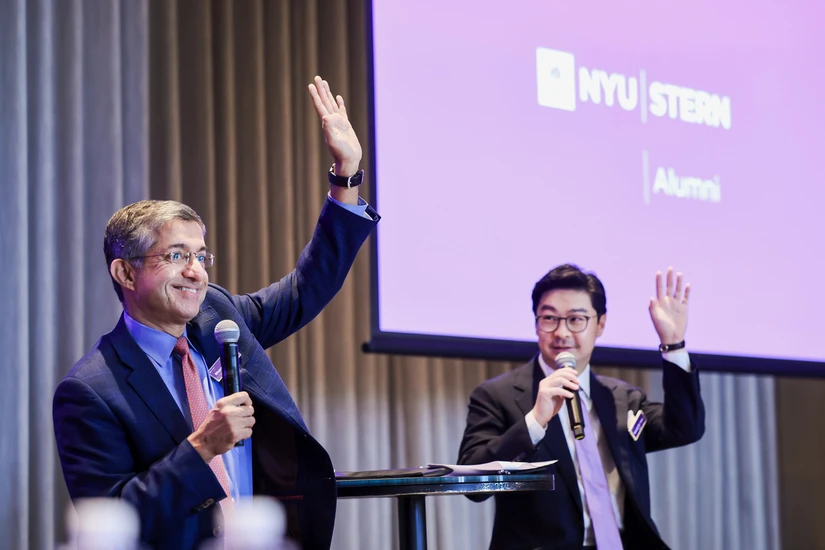
Photo: Dean Anand at the Dean’s Alumni Breakfast in Shenzhen as part of the NYU Pan-Asia Alumni Conference
What’s exciting to you about Stern’s next chapter?
What excites me most is the opportunity to work with wonderful colleagues to do our part in reimagining what a great business school can be. How can we bring together an extraordinary combination of assets: New York City, with its unmatched proximity to industry; NYU’s global locations and network; and now AI, which creates entirely new possibilities when layered on top of those strengths? And how can we use that combination to strengthen everything we do, from creating transformative experiences for our students, to advancing research, to engaging more deeply with the world around us? Those are incredibly exciting questions to work on together.
You published an article in Harvard Business Review that offers an AI framework that won the 2025 HBR Prize for the best article published in the magazine. Can you share a few takeaways for how companies should approach an AI strategy?
A core message of the article is that AI transformation isn’t primarily a technology problem; it’s a management and strategy problem. Most conversations about AI seem to cycle between hype and gloom. But even with all its limitations, AI is ready for use across many settings today. The first part of the article offers a simple guide for how to think about using it: where AI can replace human effort, where it should complement it, and where you probably shouldn’t use it at all.
The second part makes a different point: even if you use AI in all the right places, you might see surprisingly little P&L impact. One reason is what we call missing task complementarities: you improve one task with AI, but a related task doesn’t change and becomes the new bottleneck. Getting real value often requires rethinking the broader workflow, not simply making individual tasks more productive.
Another reason is the paradox of access: if everyone has access to the same powerful technology, the benefits from adopting it can quickly get competed away. So the real strategic question isn’t simply, ‘How do we use AI?’ It’s ‘How do we use AI in a way that makes us more distinctive?’ That’s a simple question to ask and a much harder one to answer. And it can’t simply be delegated to the CTO or the technology team. These are ultimately questions about where the organization creates value and how it will compete. The seniormost leaders in the organization have to own them.
What are you enjoying about living in NYC?
The best part about NYC is my five-minute walk to work. And the worst thing is my five-minute walk to work because I don’t get the chance to see more of the city! But when I do get out and explore, I notice how distinct the neighborhoods are. I love the diversity of the food—Chinese, Mexican, Indian, Italian, Korean—so much choice. It’s great. When my wife moved here from Boston, the first Saturday we were walking around the West Village, and she said, ‘I think I'm gonna love this place.’ I feel the same way.
NYU Stern Dean Bharat Anand In Conversation with A. R. Rahman
What can business students learn from an award-winning musician? Here’s a glimpse of the conversation between NYU Stern’s Dean Bharat Anand and the world-renowned A. R. Rahman, at an event for our MBA students.

Dean Anand’s Co-Authored “The Gen AI Playbook for Organizations” Wins 2025 Harvard Business Review Prize
Harvard Business Review (HBR) named NYU Stern Dean Bharat N. Anand’s co-authored article, “The Gen AI Playbook for Organizations,” the winner of the 2025 HBR Prize, awarded each year to the best article published in the magazine.
