
Alumni
Will Sheehan (MBA ’23) Establishes Scholarship Supporting Military Veteran Students at NYU Stern
—
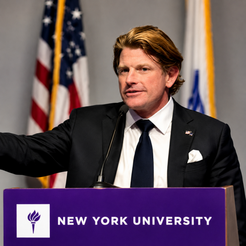
As a military veteran and Stern Executive MBA graduate, Will Sheehan (MBA ’23) shares what drove him to a life of service, how Stern helped shape his next chapter, and why he established a scholarship supporting military veterans in the Langone Part-time MBA Program.
For Will Sheehan (MBA ’23), leadership has always begun with service. Growing up in Bayonne, New Jersey, the son of a police officer and a teacher, Sheehan learned early the importance of loyalty, resilience, and showing up for others. Those values would shape a career dedicated to public service — first as a SEAL Team Intelligence Officer and veteran of Operation Iraqi Freedom, and later as an entrepreneur, investor, philanthropist, and alumni leader.
Now, Sheehan is giving back to the next generation of military veteran students at NYU Stern through a newly established scholarship supporting veterans enrolled in the Langone Part-time MBA program.
Created to complement the Fertitta Veterans MBA Program, which provides significant financial and transition support for veterans in Stern’s Full-time MBA program, the Sheehan Scholarship extends Stern’s commitment to veteran success by supporting those pursuing a degree through the Langone Part-time MBA Program. These students often balance full-time careers, family responsibilities, and academic demands while pursuing their MBA, making dedicated scholarship support an important resource in helping them achieve their educational and professional goals.
For Sheehan, the decision to create the scholarship was deeply personal.
“The transition out of military service can be difficult,” he says. “You lose more than a job. You lose the mission, the structure, and often the community that helped define you. Stern was a bridge for me, and I wanted to help create that same bridge for other veterans.”
Sheehan traces his understanding of leadership back to the day he left for the United States Naval Academy, when his father offered him a lasting piece of advice: “The first trait of a leader is to look out for the welfare of your people.”
“That lesson stayed with me through Annapolis, the military, and public service,” Sheehan says. “Leadership is about making sure the people in front of you and behind you have what they need to succeed.”
Stern’s Executive MBA connects students with real-world experience from across industries
After military service, Sheehan chose Stern because of its unique combination of academic rigor, ambition, and connection to New York City.
“I wanted a place that would challenge me intellectually and put me around people operating at a high level across finance, business, technology, government, and culture,” he says. “NYU is not just a school — it is an ecosystem of talent, ideas, and innovation.”
He found that environment especially valuable in the Executive MBA program, where classmates brought real-world experience from across industries including finance, entrepreneurship, technology, consulting, and public service.
“The biggest benefit was the people,” he says. “Every conversation sharpened how I thought about business and markets.”
Today, Sheehan is Founder and Managing Director of Sheehan Strategies, a family office and investment platform focused on public equities, private companies, real estate, and emerging business opportunities. He also serves as President and Chairman of the Sheehan Foundation and Founder of Breakers Row Capital, a public markets investment platform focused on emerging technology and AI infrastructure.
Sheehan splits his time between Palm Beach, Florida, and the New York/New Jersey area, and remains deeply connected to NYU. He serves on the NYU Alumni Association Board of Directors and previously co-chaired the fundraising committee for One Day, the University’s annual day of giving.
For Sheehan, supporting veterans at Stern reflects a broader commitment to helping others navigate moments of transition and growth.
“Veterans have already proven they can serve something larger than themselves,” he says. “The question is whether we give them the tools, network, and opportunity to carry that service into the next chapter.”